Auteur : Henrik Morlock

Copyright: Daimler A. G.

Détails de l'image :

  • Résolution: 4961×3307 @ 300×300 DPI 42,00×28,00cm
  • Taille du fichier: 4.78 MB
  • Mise en ligne par : Доцент , il y a 2 ans
  • Statut de l'image: Acceptée

Toutes les images ont leur propriétaires.

Si vous penser que les utilisateurs du site on fait une erreur en postant cette image dans cette section, il serait bien si vous nous en informiez dans les commentaires, en nous expliquant l'erreur.

Vous pouvez discuter de tout et juste parler de voitures sur le forum.

Commentaires

il y a 2 ans
Доцент

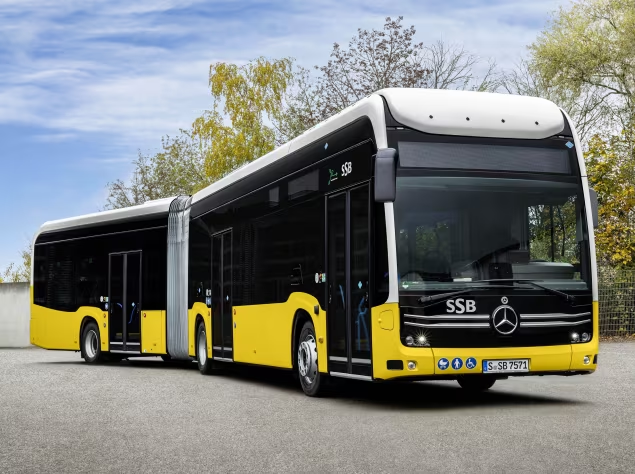
Mercedes-Benz eCitaro G fuel cell with H2-Mode '2024

le mois dernier
Wheels&Tracks

28 April 2025

The first of a 10-units order of Mercedes eCitaro G with the new pure hydrogen H2 drive mode has been delivered to Stuttgarter Straßenbahnen AG (SSB) in 2025, the state capital of Baden-Württemberg. SSB has been a development partner of Daimler Buses for the Mercedes-Benz eCitaro G fuel cell with H2 mode.

SSB will no longer be purchasing diesel buses: from 2027, it intends to operate in the city centre of Stuttgart exclusively with emission-free buses, and from 2035 to be climate neutral across the entire Stuttgart bus network.

On 14 April 2025, the first of the ten new fuel cell buses with H₂ mode was presented in Stuttgart.

With the new H₂ mode operating strategy, presented in November 2024, the eCitaro G fuel cell electric articulated buses equipped with a hydrogen-based fuel cell as a range extender can be operated exclusively with hydrogen as an energy source in certain operating scenarios. The pure hydrogen drive mode makes them independent of stationary charging processes. This increases their operating radius compared to hybrid or purely electric technologies, Daimler Buses states.

The battery and the fuel cell are also the energy source for the drive system in the “H₂ mode” operating strategy. However, external charging of the batteries on the mains network during stationary phases is no longer necessary, as they are charged by the fuel cell while driving. The fuel cell always operates in the efficient operating range between 20 and a maximum of 40 kW, even in H₂ mode, the group adds.

The Mercedes-Benz eCitaro G fuel cell vehicles for SSB are equipped with four NMC3 high-voltage battery packs with a total energy capacity of 392 kWh. The compact fuel cell module has a maximum output of 60 kW and is located on the roof of the rear section directly behind the articulation joint. Six hydrogen tanks each with a total capacity of 30 kilogrammes of H₂ are located on the roof of the individual articulated buses.

The eCitaro G fuel cell articulated buses with H₂ mode from the Stuttgart-based SSB are each equipped with 47 City Star Eco passenger seats in blue-yellow fabric covers (plus driver’s seat) and a powerful Thermatronic air conditioning system. In the première vehicle, four seats in the front area, which were designed in striking grey with a red crossbar and the logo of the VfB Stuttgart premiership football team, underline the SSB’s close ties with the sporting representatives from the Baden-Württemberg state capital.

In addition, there are 77 standing spaces, so that up to 124 passengers per bus can be transported at the same time in spacious and comfortable surroundings. The new fuel cell articulated buses with H₂ mode feature all-round LED lighting technology, roll-pitch control and electrohydraulic intelligent eco steering.

Highlights on board the articulated buses are the state-of-the-art safety including Sideguard Assist 2 and Frontguard Assist, Traffic Sign Assist, Attention Assist and the tyre pressure monitoring system (TPM). There is also a reversing camera, a video surveillance system with five mini dome cameras and an 8″ TFT LCD colour monitor as well as an accident data recorder.

https://www.sustainable-bus.com/fuel-cell-bus/mercedes-fuel-cell-buses-stuttgart-ssb/

Pour pouvoir poster un commentaire, vous devez créer un compte ou de vous connecter en utilisant le compte des réseaux sociaux

WheelsAge.org '2005–prés.