JCB dans l'ordre chronologique
JCB Mark I '1953–57Produit à environ 550 exemplaires
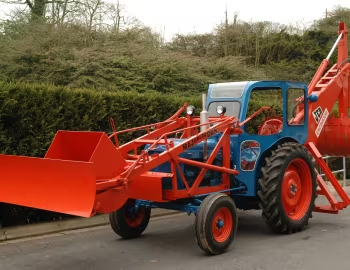
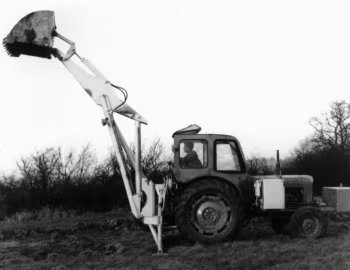
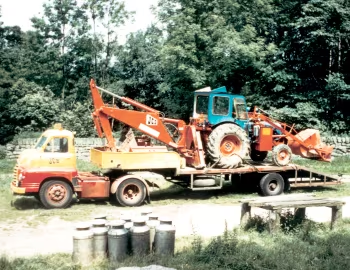
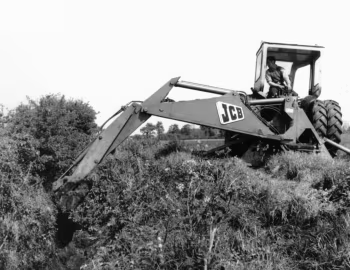
The machine came in blue and red livery.
In 1953, Joe Bamford developed the world’s first backhoe loader by adding a backhoe onto the back of a Major Loader - essentially a Fordson tractor with a hydraulic excavator at the rear, a Major Loader at the front and an optional cab. The JCB logo also appears for the first time.
JCB Hydra-Digga '1957–58
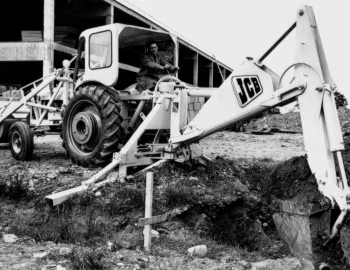
The first JCB machine to provide a comfortable cab. The machine came in blue and red livery. It had originally been named the "Digall" but was changed to "Hydra-Digga" just before introduction in 1957.
JCB Hydra-Digga/Loadall '1957–60Produit à environ 1800 exemplaires
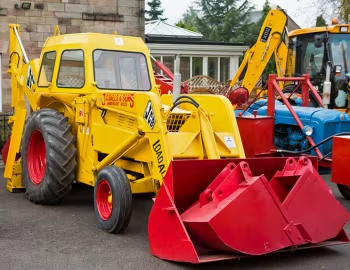
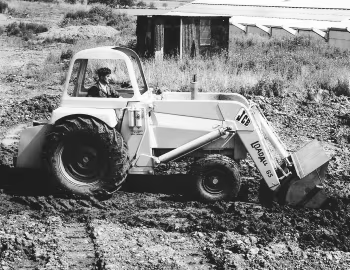
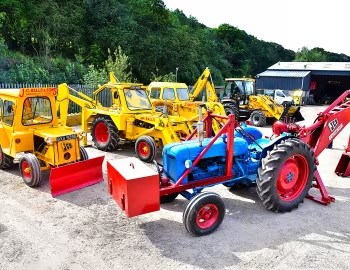
After the Mk 1, JCB introduced the Hydra Digga in 1957 which, in turn, was combined with the Loadall to make the Hydra Digga/Loadall, that went on to sell over 2,000 units before production ceased in 1960. Larger and more powerful than its predecessors, it was advertised as "the earth mover that could dig through rock". As well as its improved boom and dipper, it was the first to provide the operator with a comfortable cab, and became the first, mass-produced backhoe loader in the UK. Latterly named the Loadall 65, it was the first JCB to feature a hollow chassis that was used to store hydraulic oil – a feature that all JCB loaders utilised until 1990.
JCB Hydra-Digga Loadall '1958
The first JCB machine featuring an innovative hydraulic shovel. JCB Hydra-Digga and JCB Loadall were combined to form the JCB Hydra-Digga Loadall.
JCB Hydra-Digga Loadall 65 '1958–60
JCB Hydra-Digga Loadall 65 was fitted on a 52-horsepower Fordson Major tractor as the base power unit.
- Digging depth - 3,96m;
- Reach - 5,48m;
- Discharge height - 3,20m;
- Front bucket lift height - 4,29m;
- Dump height - 2,90m.
JCB 4 '1960–62


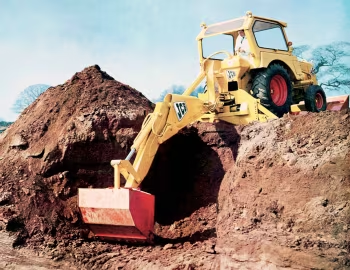
JCB 4 was the first machine painted in yellow.
In 1962, Joseph Bamford originates the much-loved tradition of JCB stunts. The first is the "up and over", in which a JCB 4 lifts itself up on its two hydraulic arms to form a bridge, while the company Cadillac drives underneath.
The stunts showed off the power, performance and versatility of JCB machines, evolving into the JCB Dancing Diggers shows, famous throughout the world.
WheelsAge.org '2005–prés.