Détails de l'image :

  • Résolution: 4000×2667 @ 300×300 DPI 33,87×22,58cm
  • Taille du fichier: 1.1 MB
  • Mise en ligne par : Доцент , il y a 2 ans
  • Date prise: 18.03.2024
  • Statut de l'image: Acceptée

Toutes les images ont leur propriétaires.

Si vous penser que les utilisateurs du site on fait une erreur en postant cette image dans cette section, il serait bien si vous nous en informiez dans les commentaires, en nous expliquant l'erreur.

Vous pouvez discuter de tout et juste parler de voitures sur le forum.

Commentaires

il y a 2 ans
Wheels&Tracks

- Frame No. 635435;

- Engine No. FCE 435;

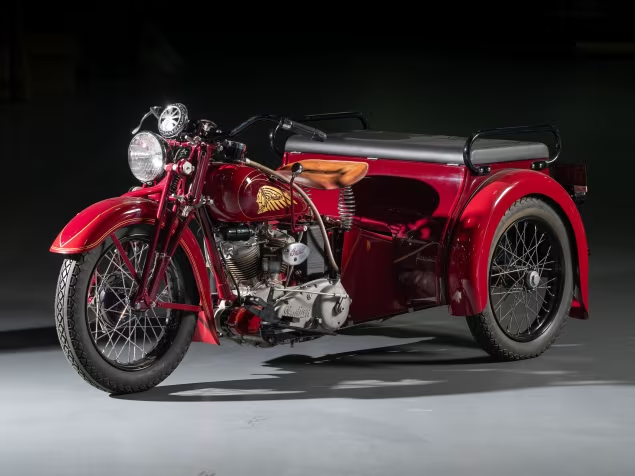
- 45-cu. in. air-cooled V-twin engine; distinctive three-wheel configuration with rear axle and leaf spring;

- Intended for the auto service industry; designed to be towed behind a customer car.

In 1931, the Indian Motocycle Company of Springfield, Massachusetts introduced the Dispatch Tow, a motorcycle designed to meet the highly specific, somewhat quaint, needs of the era’s automotive dealership industry in an unexpected way. As the story goes, a cost-conscious local Packard dealer was tired of using two mechanics to bring cars to and from customers’ homes to the shop for service. Sensing opportunity, Indian quickly developed its popular Scout model into the Dispatch Tow, a three-wheeled machine with a rear axle featuring a differential mounted on a single transverse leaf spring.

Although the timing of the story is somewhat questionable (Indian was apparently experimenting with three-wheeled vehicles at this point well before any Packard dealers entered the picture), the Dispatch Tow did incorporate an interesting feature: A tow bar that attached near the motorcycle’s front wheel. The idea was that, instead of using two mechanics for customer-car pickup and drop-off, a dealership could send one man on a Dispatch Tow; once at the customer’s house, he would deploy the Indian’s tow bar, bolt it temporarily to the customer car’s rear bumper, and drive himself and the motorcycle to the service garage. After the service work was complete, he would simply reverse the process. Presumably this labor-saving innovation would quickly pay for itself—at least if the Indian salesman was to be believed!

Indian did not produce many examples of the Dispatch Tow, but the concept did have some merit: Competitor Harley-Davison followed Indian’s lead when it introduced the Servi-Car in 1932; the Harley-Davidson trike would remain in production for decades.

Pour pouvoir poster un commentaire, vous devez créer un compte ou de vous connecter en utilisant le compte des réseaux sociaux

WheelsAge.org '2005–prés.